
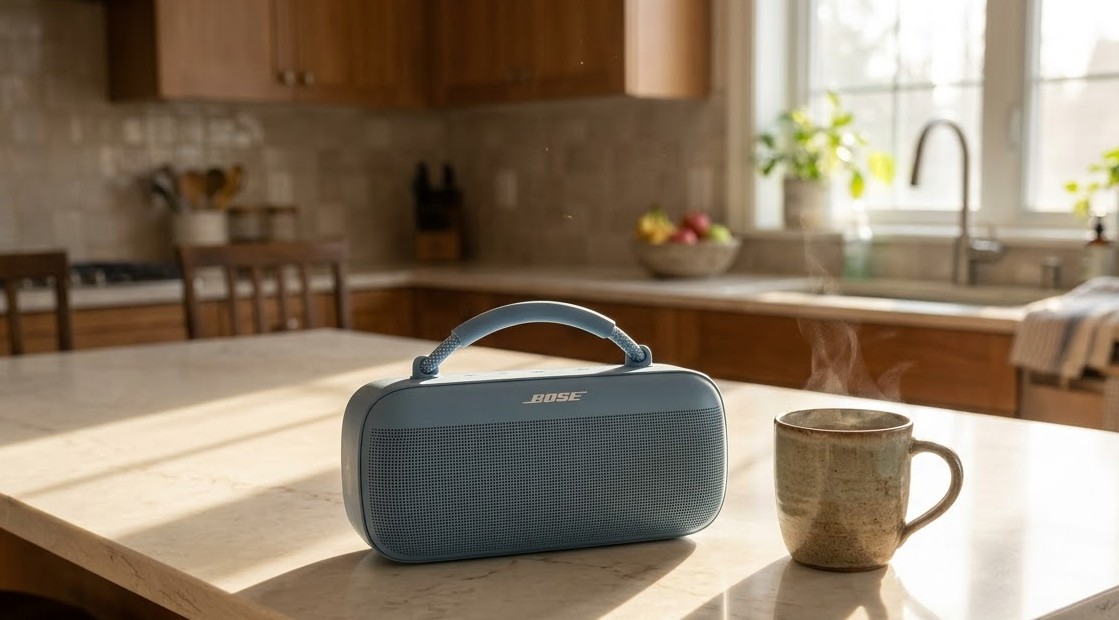
Premium Audio
Look, I’m going to be straight with you—I did not want to like this speaker.
Not because I have anything against Bose. I’ve owned Bose stuff before. The QC35s got me through a decade of flights, and my old SoundLink Mini survived a coffee spill and a toddler. But the Bose SoundLink Max review conversations happening online had me suspicious.
“It’s too heavy.” “It’s too expensive.” “The JBL Xtreme 5 smokes it on paper.” And here in India, the price situation felt… off. ₹41,900 MRP for a Bluetooth speaker? That’s a used car down payment in some parts of the country.
But here’s the thing about audio—paper doesn’t sing. Spec sheets don’t make you close your eyes at 11 p.m. on a Tuesday because a song you’ve heard a thousand times suddenly has texture you never noticed.
So I bought one. My own money. And for the first three days, I was this close to initiating a return. The bass felt heavy-handed at low volumes. It took five hours to charge. There’s no microphone—no microphone, in 2026. I sat on my couch, looked at this 2.2-kilogram brick, and thought: this is it? This is the ₹30,000 Bose experience?
But I didn’t return it. And somewhere between the second weekend and the first month, something shifted. I’ve spent a month living with this thing—taking it to a rooftop party in Bengaluru where someone spilled a drink on it (it shrugged), a weekend trip to Coorg where it got rained on (also shrugged), and dozens of unremarkable evenings at home.
Here’s what you’re going to get in this review:
A proper breakdown of what this speaker is, the features that actually matter versus the ones that just look good on a box, the two or three moments where it genuinely surprised me, and the honest list of things that still bother me.
If you’re the kind of person who wants the real version, flaws and all, before dropping thirty grand on a portable speaker, you’re in the right place. Let’s do this properly.
Quick Bose SoundLink Max Summary
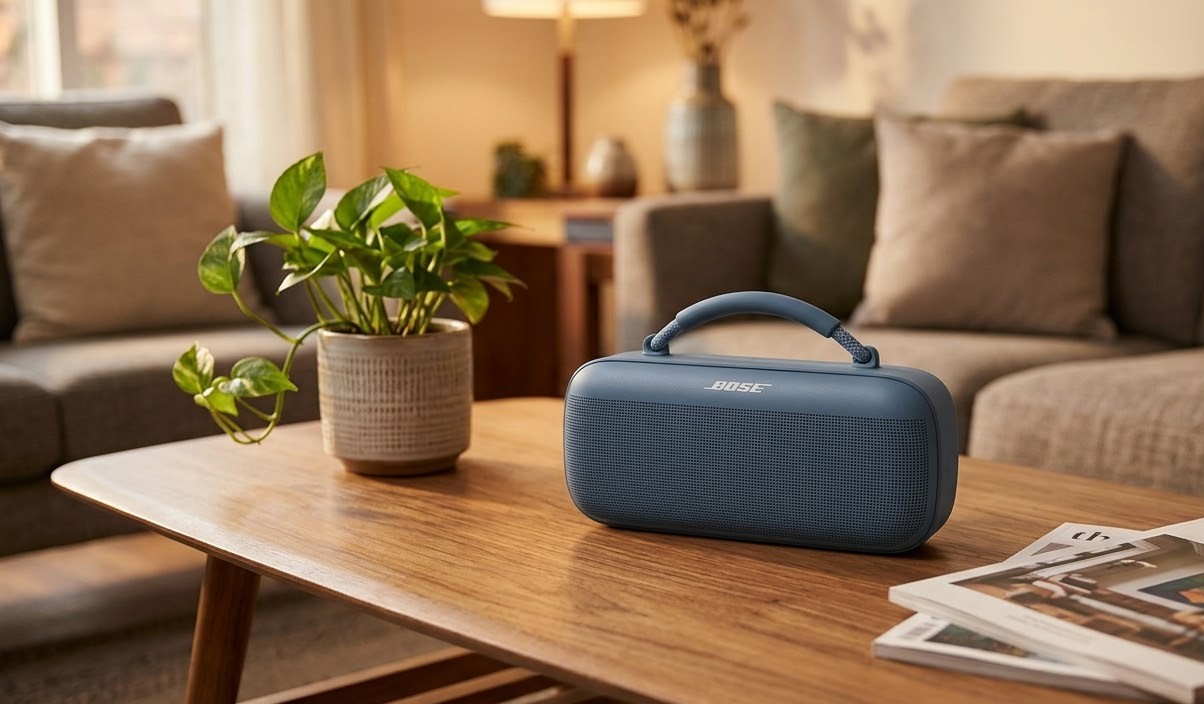
People who actually go outside—terrace parties, poolside Sundays, camping trips. Anyone who values deep, rich bass and a premium, drop-it-and-it-survives feel over spec-sheet gymnastics.
❌ Not For
Podcast-and-phone-call people (no mic). Audiophiles who want flat, studio-reference sound—this thing is fun, not forensic. And anyone who wants to pair two speakers for stereo (Bose locked that door).
⚙️ Key Features
Bose-tuned with dedicated subwoofer/tweeter.
Waterproof, dustproof, shock & rust-resistant.
With USB-C power-bank output to charge your phone.
Bluetooth 5.3 + 3.5mm AUX input for wired sources.
💸 The Price Reality
MRP ₹41,900
Realistically, it sells for ₹29,990 on Amazon India during sales. At full MRP, I’d wince. At ₹29,990, it’s a conversation.
See what I mean? The numbers tell a story, but they don’t tell the story.
If you’re willing to let a product grow on you, then keep going. The next section is where things get real: what happened when I stopped reading the spec sheet and started living with it.
What Is the Bose SoundLink Max, Really?
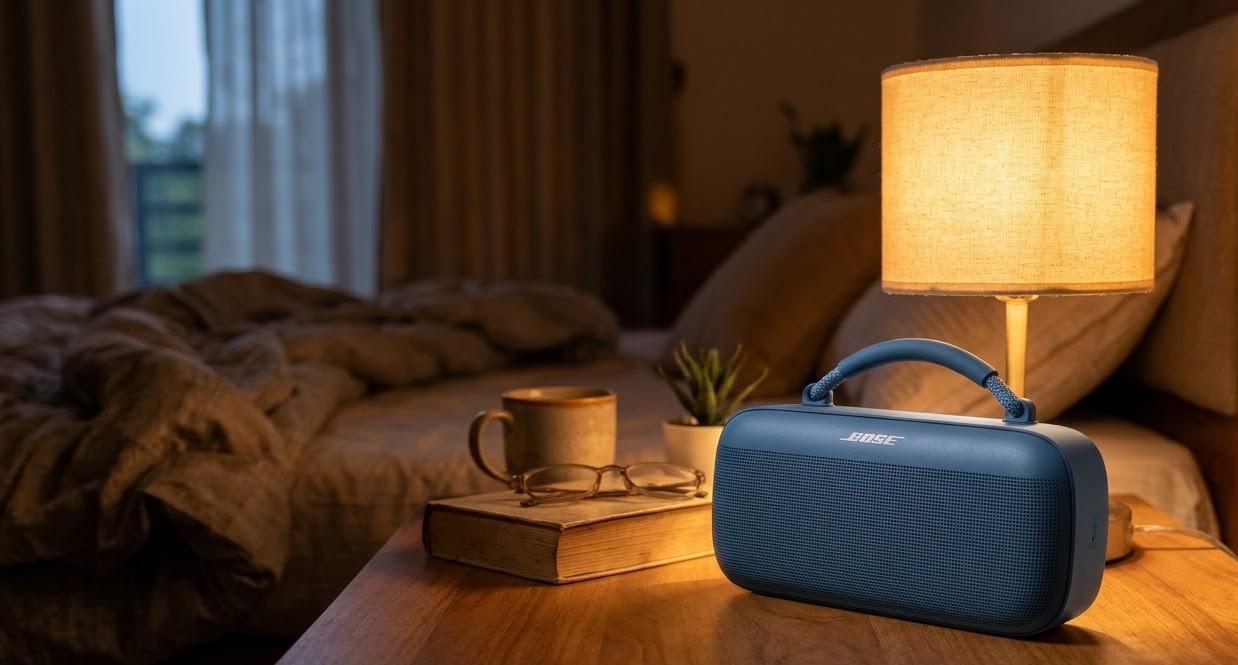
Strip away the marketing language and the Bose SoundLink Max is a premium, rugged, portable Bluetooth speaker designed to be the loudest, bassiest, most durable box Bose has ever put in a grab-and-go form factor.
It sits above the SoundLink Flex and the SoundLink Micro in Bose’s lineup—it’s the “big one” you buy when the Flex isn’t enough for a terrace full of people and you don’t want to drag a PartyBox around.
The Hardware Reality
✓ 36 Hz Frequency: Unheard of for this size.
✓ 50W–180W Output: Loud enough to rival the JBL Xtreme 4.
✓ 2.22 kg Weight: Not a pocket speaker.
✓ IP67 Rating: Submersible, dustproof, shock-resistant.
✓ Bluetooth 5.4: SBC, AAC, and aptX Adaptive.
✕ No Wi-Fi & No Mic.
The body is a mix of aluminum, fabric, nylon, plastic, silicone, and steel, finished with that signature removable climbing-rope handle.
The “Ingredients”: What’s Actually Inside
I promised I’d describe the ingredients. Think of it like a recipe: the drivers are the main ingredients, the passive radiators are the seasoning, and the DSP is the chef’s technique.
Handle the bulk of the music—vocals, guitars, synths, the body of the sound.
Sits above them and handles the sparkle: cymbals, hi-hats, the air around acoustic instruments.
The secret sauce. Tuned membranes that move passively, effectively extending the bass response. This is why it hits notes a speaker this size has no business hitting.
Bose’s DSP then massages the signal to keep the drivers from tearing themselves apart when you crank it—which is a double-edged sword.
How Does It Work?
(And What It’s Like to Actually Live With)
Using the SoundLink Max is almost aggressively simple. You hold the power button, it plays a chime (or announces battery), and you pair via Bluetooth (supports Google Fast Pair). The Bose app unlocks the EQ—bass, mid, and treble sliders—and lets you assign a shortcut button.
⚠️ The Big Limitation
There’s a party mode for other Bose speakers, but here’s the kicker: the SoundLink Max cannot be stereo-paired with another SoundLink Max, and it won’t connect to non-Bose speakers. That’s a real limitation.
The 3.5mm AUX input is a lovely throwback (I plugged a turntable into it—worked without fuss). The USB-C port is bidirectional: you can charge the speaker, or use its 4,600 mAh battery to charge your phone. I tested this on a train: 20 minutes gave my phone +22%. It’s not fast charging, but it’s a genuinely useful emergency feature.
My Hands-On Experience
Day 1 vs. Day 30
Day 1
The “What Have I Done?” Phase
The first thing you notice is the weight. It feels like it was machined, not molded. I set it on my counter, paired it, and pressed play. And… I was underwhelmed.
The bass felt heavy-handed at low volumes. The sub-bass thump was almost distracting, overwhelming the vocals. I had to pull the bass EQ down to -2. Then came the charging: 5 hours to full. I’ve charged laptops faster.
Day 7
The “Okay, Wait” Phase
I’d started using it without thinking. That’s the thing about good gear—it stops being a decision and becomes a habit. I took it to a terrace party where someone knocked it off a table onto concrete. It bounced, skidded, and kept playing.
The battery started making sense. At 50–60% volume (plenty loud), I got 12–14 hours of real-world playtime. At full volume, expect 3–5 hours—the dirty secret of every “20-hour” speaker. But I rarely needed full volume.
Day 30
The “I Get It Now” Phase
I stopped thinking about it as a review unit and started thinking of it as the speaker. The thing I grab on the way out the door.
Playing Pink + White by Frank Ocean on the balcony, something clicked. The bass wasn’t punchy—it was deep. It wasn’t boomy—it was warm. The vocals sat forward, the keys shimmered. This is what Bose sells: coherence. The drivers and DSP make music sound like music, not frequencies fighting for attention.
Key Features & Benefits
The Deep Dive. Let’s break down the features that actually matter, how they held up, and what they do for you.
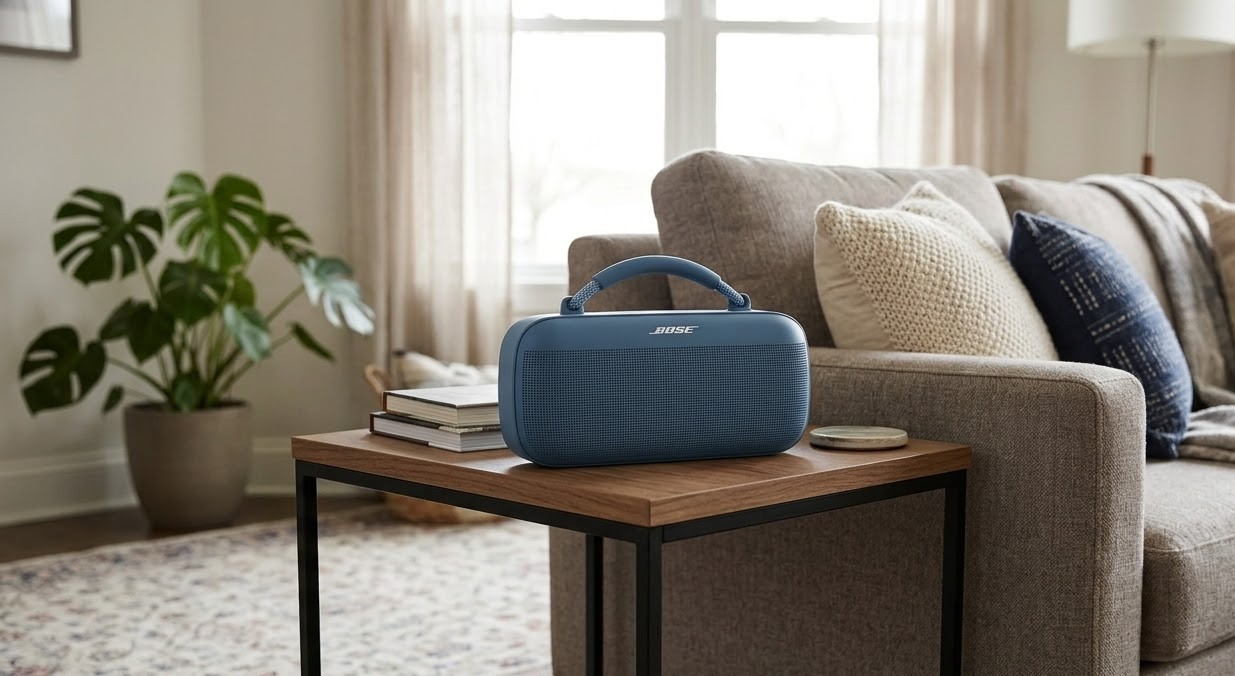
1. The Driver Array and Bass Response (36 Hz)
What it is: Two midranges, one tweeter, and two passive radiators, tuned down to 36 Hz.
The benefit: So you can feel the low end of a track without a subwoofer. So you can fill a room with sound that has weight.
My experience: At moderate volumes, bass is genuinely deep. PCMag called it “full-bodied,” and I agree. At maximum volume, the DSP reins in the deepest bass to protect drivers. But at 70–80%, the balance is excellent.
2. IP67 Durability (Water, Dust, Shock)
What it is: Submersible to 1 metre for 30 mins, plus shock/rust resistance.
The benefit: So you can stop treating it like fragile electronics and start treating it like outdoor gear.
My experience: Left it in the rain for 20 mins; watched it tumble onto concrete. Came back without complaint. The rope handle makes the 2.2 kg weight manageable.
3. 20-Hour Battery (With an Asterisk) & USB-C Power Bank
What it is: 4,600 mAh battery (20 hrs moderate / 3 hrs max vol). Charges in up to 5 hours.
The benefit: So you can get through a full day of listening. So you can top up your phone.
My experience: Got 12–14 hours at 50–60% volume. Under 4 hours at max. The power-bank feature is useful. The 5-hour charging time is the real pain point—archaic in 2026. Mitigation: charge overnight.
4. The Bose App and Adjustable EQ
What it is: App with bass, mid, treble sliders, presets, and a shortcut button.
The benefit: So you can fix the low-volume bass heaviness. Make it sound the way you want.
My experience: The EQ is essential, not optional. With bass pulled back two notches, it’s balanced and lovely. The shortcut button (set to Spotify) is a lifesaver with wet hands.
5. Bluetooth 5.4 with aptX Adaptive & AUX Input
What it is: Bluetooth 5.4 (SBC, AAC, aptX Adaptive) + 3.5mm AUX input.
The benefit: So you can get lower latency on Android. So you can connect non-Bluetooth sources.
My experience: Solid Bluetooth range. AUX is a lifesaver for turntables. The lack of Wi-Fi is a real omission at this price (unlike Sonos Move 2).
6. Build Quality, Design, & the Rope Handle
What it is: Aluminum grille, silicone base, and a removable climbing-rope handle.
The benefit: So you can feel good about owning it. Carry it comfortably despite the weight.
My experience: The most premium-feeling portable speaker I’ve handled. Rope handle is genuinely ergonomic. Only gripe: the top button layout looks like it should have a mic/call button, but it doesn’t.
7. Stereo Sound from a Single Box
What it is: A stereo speaker array with angled drivers for a wide soundstage.
The benefit: So you can get left-right separation without pairing two speakers.
My experience: Soundstage is wide but not magical. For a single box, it’s impressive—vocals sit centre, instruments spread out. Angled drivers help you hear stereo even off-axis.
Pros and Cons Table
✅ Pro
Exceptional build quality—aluminum, silicone, steel, and a rope handle that feels like it’ll outlast the electronics.
❌ Con
No microphone. Cannot take calls. Mitigation: Use your phone’s speaker; this is a music speaker first.
✅ Pro
Deep, rich, well-judged bass at moderate volumes, with EQ to tame/boost.
❌ Con
Bass can overwhelm at low volumes (kick bass thump). Mitigation: Use app to pull bass down two notches.
✅ Pro
IP67 durability—water, dust, shock, rust-resistant. Survived concrete drop and rainstorm.
❌ Con
5-hour charge time—glacial. Mitigation: Charge overnight; 12-14 hr battery is enough for a day.
✅ Pro
USB-C power-bank output—charge your phone in an emergency.
❌ Con
No Wi-Fi & no multi-speaker pairing. Can’t stereo-pair two Max units. Mitigation: Look at Sonos Move 2 for multi-room.
✅ Pro
App-based EQ & shortcut button—useful customization that fixes tonal quirks.
❌ Con
Heavy and bulky (2.22 kg). It’s transportable, not a pocket speaker. Mitigation: Rope handle makes it easy to carry.
✅ Pro
Loud enough for outdoor gatherings—fills a terrace without distortion at 70–80% vol.
❌ Con
Expensive at MRP (₹41,900). Mitigation: Buy during sale (₹29,990); value proposition changes dramatically.
Who Is This Product For?
(And Who It Isn’t For)
After a month with this thing, I’ve realized the question isn’t “is it good?”—it’s “is it good for you?” Let me save you some time and money by being blunt.
✅ You Should Buy the SoundLink Max If…
- •
You actually leave your house with a speaker. If you bring music to terrace parties, poolside Sundays, camping trips—the IP67 rating and 2.2 kg of reassuring heft make sense. “It can fill up the entire room of even big size with its sound.”
- •
You value bass depth and coherence over raw volume. It’s for deep, rich bass that supports music rather than smothering it. “Superb separation for my audiophile ears.”
- •
You’re willing to spend five minutes with an app. The EQ is essential. Pull bass down two notches, save a preset, and it transforms.
- •
You care about longevity. Bose has a reputation for a reason. “I have owned a gen one soundlink bought in 2015… All three even today work like new.”
🚫 You Should Walk Away If…
- •
You take a lot of calls on your speaker. There is no microphone. Genuinely baffling at ₹30,000.
- •
You want to stereo-pair two speakers. You can’t pair two Max units. No Wi-Fi for multi-room. (Look at Sonos Move 2 instead).
- •
You’re a basshead chasing party-speaker impact. “This would not give u the effect of a jbl party box.” If you want chest-thumping bass that rattles pictures, look at the JBL Xtreme 5.
- •
You’re on a tight budget. At MRP ₹41,900, it’s a hard sell. Even on sale at ₹29,990, it’s a premium product. A JBL Charge 5 gets you 80% of the way there for a third of the price.
Alternatives & Comparison
The Part That Actually Helps You Decide
Right, here’s where I earn my keep. No affiliate marketer worth their salt would give you a review without acknowledging that this is a crowded, brutal market. The ₹10,000–₹35,000 portable speaker segment is where the fight is fiercest. Let me walk you through the unvarnished truth about the alternatives.
What Real Customers Are Saying
The Good, the Bad, and the Honest from Amazon India.
😍 The Raves
“The bass is as thumping, clear, butter smooth as it ever could be… EACH instrument is rendered crystal clear.”
“The audio is deep, rich, and completely fills the room, it feels like a portable surround sound system.”
😤 The Complaints
“Battery draining very fast. Sound clarity and performance is less than Revolve Plus.”
“Its expensive which means paying more of a underperforming product.” (Note: One reviewer reported a battery failure just past the 1-year mark).
⚖️ The Balanced Take
“Very good BT speaker. Worth of cost for its look and typical lively sound.”
“Great looks and sound… The cherry on the cake was I got this for 31,000 on Amazon sale day with card offers.”
The pattern? People who bought it at sale price are delighted. People who paid full MRP feel the sting.
The 8 Benefits That Actually Matter
1. Deep, well-judged bass
So you can feel the low end without a subwoofer.
2. IP67 durability
So you can stop treating your speaker like a fragile ornament.
3. 20-hour rated battery
So you can get through a full day without anxiety (12-14 hrs real-world).
4. USB-C power-bank
So you can charge your phone in an emergency.
5. App-based EQ
So you can fix low-volume bass heaviness and tailor the sound.
6. Premium build quality
Aluminum, silicone, and a rope handle that outlasts the electronics.
7. Loud enough outdoors
So you can fill a terrace without distortion at sensible volumes.
8. Aux input
So you can connect a turntable or TV (rare feature in 2026).
Pricing and Discount: The ₹30,000 Question
Here’s the truth. The MRP is ₹41,900. That is, frankly, too much. At full price, I would have returned it.
But during the Amazon Great Indian Festival sale (and other sale cycles), it drops to ₹29,990—a 28% discount. Users have reported paying ₹31,000 with card offers.
My Honest Advice:
Do not buy this at MRP. Wait for a sale. The difference between ₹41,900 and ₹29,990 is the difference between “I regret this” and “this was a considered purchase.” At ₹30,000, you’re paying a premium for Bose’s tuning, build quality, and longevity, but you’re no longer being gouged. The speaker is worth ₹30,000. It is not worth ₹42,000.
Final Verdict — Is it Worth It?
So here we are. Thirty days, one concrete drop, one rainstorm, dozens of listening sessions, and a lot of soul-searching later. What’s the verdict?
I kept it. That’s the headline.
What I love:
The sound is coherent. The bass is deep and warm. The build quality makes every other portable speaker feel like a toy. 12-14 hrs real-world battery is enough. The IP67 rating means I’ve stopped worrying about it, which is a luxury in itself.
What still bugs me:
No mic. No Wi-Fi. No stereo pairing. A 5-hour charge time that feels like a relic. A default tuning that requires the app EQ. These are the reasons it gets a 4/5 and not a 5/5.
Is it worth the money? At ₹29,990, yes—if you’re the right kind of buyer. If you value sound/build over feature count, take your speaker places, and will use the app, this is genuinely special. At ₹41,900, no—wait for a sale.
If I’ve convinced you that the Bose SoundLink Max is right for you, check the best price below.
(And please—wait for a sale. Your wallet will thank you.)
Check Today’s Price on Amazon ➔
📦 Fast Delivery
🏷️ Check for Coupons
FAQ
The Questions You’re Actually Asking
Ready to Bring the Music?
If you’ve weighed the pros and cons and decided this is the speaker for you, grab it below. (And remember: keep an eye out for that sale price!)
Check Today’s Price on Amazon ➔
|📦 Fast & Free Delivery
|🏷️ Look for Card Offers