

Independent Product Review
Look, I get it. You saw the ad.
Maybe it was a YouTube pre-roll, maybe a sidebar with a grainy photo of a guy holding a multimeter next to a glowing light bulb, or maybe a friend-of-a-friend on Facebook swearing they cut their bill by 62%. The pitch is intoxicating:
~$39
$100–$150
~$250 & 1 Wknd
50%–80%
For about $39, you get a digital guide showing you how to build a “Nikola Tesla Energy Revolution System” from hardware-store parts for another $100 to $150. The promised payoff? A device that supposedly harvests ambient electromagnetic energy and converts it into usable household power—no moving parts, no noise, no emissions. Just you, some copper wire, a few capacitors, and the ghost of Tesla smiling down from inventor heaven.
Right? That’s the fantasy. And hey—I’m not here to mock you for being curious. I was curious too. The truth is, the promise is engineered to hit every nerve: distrust of utility companies, desire for self-reliance, the romance of DIY science, and the very real pain of opening a power bill that feels like a ransom note.
What This Review Covers
Before you punch in your credit card details and start watching soldering tutorials, you deserve a straight answer. This post is for anyone who’s seen the ads, read the affiliate reviews, and wants to know whether the Energy Revolution System actually works—or whether it’s another “free energy” fantasy wrapped in Tesla’s name.
We’ll look at what the product claims, what the physics says, and what your better options are. Spoiler: the physics part is where things get interesting.
The Unboxing (Well, The Download)
What the Energy Revolution System Claims to Be
1. The Core Digital Blueprint
Digital Access Only • ~$39
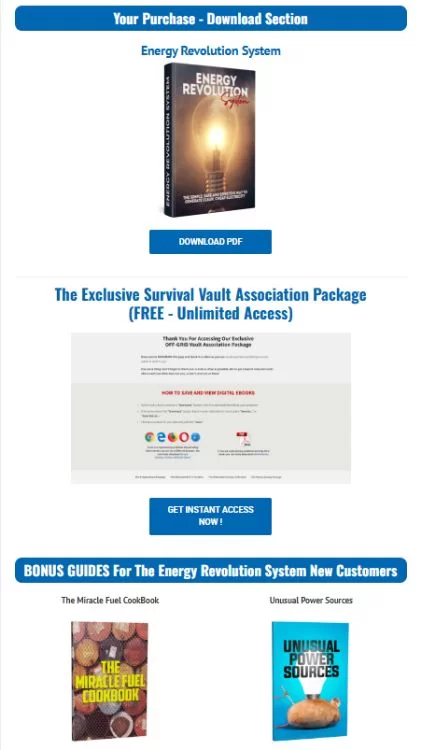
The Energy Revolution System is strictly a digital product—no physical box arrives at your door. For around $39 (pricing fluctuates with the usual “limited-time discount” theatrics), you get access to a member’s area containing PDFs, schematics, and step-by-step video tutorials that walk you through building a “functional electromagnetic generator” from scratch.
The core pitch is that you’re constructing a resonant circuit—copper coils, capacitors, a transformer, a plug, and wire—that tunes into ambient electromagnetic energy already floating around you and converts it into usable household electricity.
🧰 Advertised Off-the-Shelf Parts List
Pickling paste
Wire strippers
Screwdrivers
Isolation tube
Superglue
Power monitor outlet
1.2–1.5 mm stranded wire
🟢 One Surface-Level Green Flag: Nothing here requires a laboratory or “proprietary” parts only the seller can supply. Scam products often trap buyers into overpriced custom components—so keeping the parts off-the-shelf is a point in its favor, at least on the surface.
2. The Bonus Library
17+ Additional PDFs
Here’s where the product goes from “questionable physics” to “aggressively padded value proposition.” The sellers bundle over seventeen additional full PDF guides—not just one-page checklists—with titles like:
⚖️ Reviewer’s Take on the Padding
The strategic purpose is obvious: make $39 feel like a steal. To be fair, some of these sound genuinely interesting if you enjoy learning practical survival skills. But bundling a dozen unrelated survival guides doesn’t make the central generator claim any more plausible—it just makes the package feel heavier.
3. The 60-Day Money-Back Guarantee
Read the Fine Print Later
The sellers advertise a 60-day money-back guarantee, framed as a zero-risk proposition: download the guide, look it over, build the device, and if you’re unsatisfied, get every penny back.
On paper, that’s reassuring. In practice—we’ll dig into the fine print later, because refund policies on digital products have a way of being more conditional than the sales page suggests.
The Real Question
For now, just know that the product is positioned as a low-cost, high-reward DIY energy solution backed by a satisfaction guarantee and a mountain of bonus content.
The question isn’t whether the package is big. The question is whether the core device actually does what the sales page says it does.
And that’s where the Tesla name enters the room, wearing a lab coat and holding a giant coil.
History vs. Hype
The Tesla Connection: What He Actually Did (Versus What the Marketing Says He Did)

Ah, Tesla. The patron saint of every free-energy pitch deck, every “suppressed invention” YouTube documentary, and every $39 PDF that promises to resurrect his lost genius. Invoking Tesla’s name works because he was genuinely a visionary who thought about wireless power, resonance, and energy transmission decades ahead of his time. But there’s a difference between “ahead of his time” and “his ideas were proven to work and are being suppressed.” And that difference matters enormously before you spend your weekend soldering copper coils in the garage.
⚡ 1. What He Actually Built: The Tesla Coil (1891)
Transfer Device, Not Creation
The Tesla coil is real, and it’s brilliant. It’s an electrical resonant transformer circuit designed to produce high-voltage, low-current, high-frequency alternating current, transferring energy from a primary oscillating circuit to a secondary circuit through loose coupling across radio-frequency cycles.
A well-designed Tesla coil can transfer over 85% of the energy stored in the primary capacitor to the secondary circuit—less losses. That last phrase does all the heavy lifting: it’s an efficiency device, not a creation device.
It moves energy around cleverly, but it doesn’t conjure new joules out of the ether—and Tesla himself never claimed it did. It was built for spark-gap radio transmitters, X-ray experiments, electrotherapy, and high-voltage demonstrations, not for powering homes from ambient “free” energy.
🗼 2. The Legend: Wardenclyffe Tower
Unproven Dream, Not Suppression
Marketing loves Wardenclyffe because it’s genuinely tragic and romantic: a 187-foot transmitting tower on Long Island, funded by J.P. Morgan, meant to transmit power wirelessly across long distances—even the whole earth. Tesla had patents and Colorado Springs experiments that convinced him it was feasible.
The crucial fact: he was never able to show any practical results. Morgan pulled funding largely over concerns about excessive speculation in the wireless industry. Other financing fell through, the lab closed, and the tower was torn down to pay debts.
Wardenclyffe isn’t proof that wireless power worked and got buried—it’s proof that a brilliant inventor with an audacious dream ran out of capital before demonstrating economic viability at scale. There was no working kilowatt-scale prototype, just a tower and a dream.
Brand vs. Blueprint
Why is Tesla’s name on the Energy Revolution System sales page? Because Tesla is a brand, not a blueprint.
His name triggers an emotional shortcut: Tesla was right, the textbooks are lying, and this guide is the key they don’t want you to have.
The question to ask before buying: If this system truly rests on Tesla’s principles, why does the sales page lean on his biography instead of an independent lab test—selling the legend rather than demonstrating the physics? His name on a sales page is a marketing choice that should make you reach for your skeptical hat, not your credit card.
The Physics Audit
Does the Science Hold Up? (This Is Where Things Get Sticky)
Because the claims made by the Energy Revolution System—and the broader “free energy” genre it belongs to—don’t just strain credulity. They collide head-on with one of the most rigorously tested principles in all of science: the conservation of energy.
🎵 What’s Real: Resonance (Storage & Transfer)
The guide is right that resonance is real—a system oscillating at maximum amplitude at a specific frequency, like a swing pushed at the right moment or a guitar string vibrating sympathetically. In electronics, an LC resonant circuit stores and transfers energy efficiently between inductance and capacitance. Resonance is not magic. It’s a storage and transfer mechanism—it moves energy with less waste, but never creates it.
⚖️ The Hard Wall: First Law of Thermodynamics
Energy cannot be created or destroyed—only transformed. Any machine claiming to output more energy than it takes in is an “over-unity” or perpetual motion device, considered impossible across physics and engineering. The sales pitch sidesteps this by claiming it merely “harvests ambient electromagnetic energy”—which sounds plausible right up until you check the numbers.
By the Numbers
How Much Ambient Electromagnetic Energy Is Actually Floating Around?
Peer-reviewed research on radio-frequency (RF) energy harvesting—the most mature form of ambient electromagnetic scavenging—delivers a sobering reality check:
Often < 1 µW / cm²
Dense outdoor cellular zones may reach several thousand nanowatts/cm²; indoors it frequently drops to sub-nanowatt levels.
Tens of Microwatts
Enough to whisper faintly in a high-impedance earpiece—nowhere near household power.
~0.96 Milliwatts
Roughly one-thousandth of a single watt of usable output.
💡 The 60-Watt Light Bulb Test
A single 60-watt light bulb running for just one hour requires 60 watt-hours of energy.
At 10 microwatts of harvested RF power, you’d need roughly 6,000 hours—about eight months—just to store enough energy for ONE hour of light.
And that’s assuming 100% perfect conversion efficiency and ideal conditions that simply don’t exist in a garage.
Why the Guide’s Favorite Analogies Mislead
Looking Behind the Curtain
Now, About Those “Glowing Bulb” & Power-Meter Demos
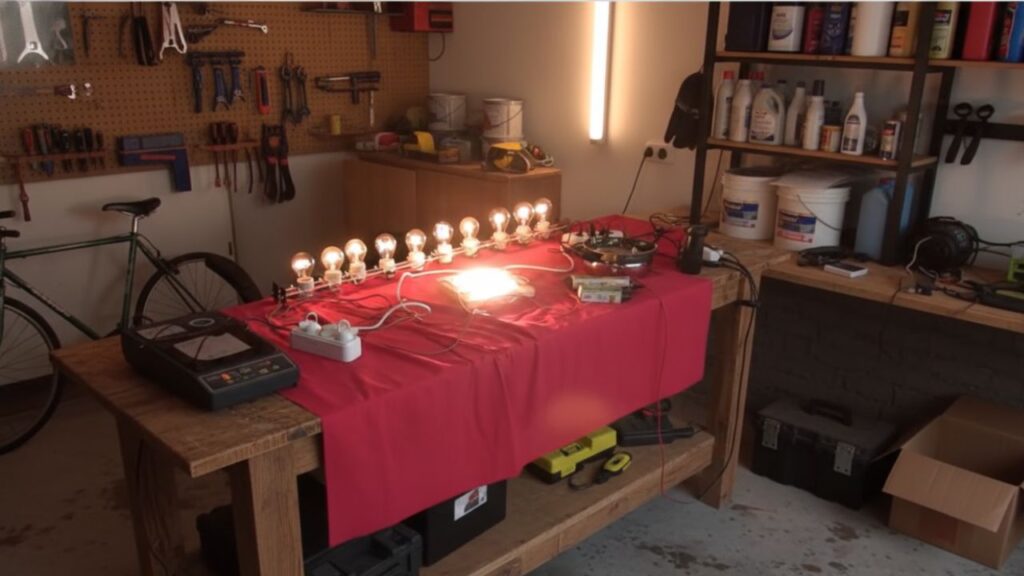
Sales pages and affiliate reviews often point to a glowing light bulb or a power meter showing a sudden drop. I’m not calling every person who reports that a liar—but a glowing bulb is not proof of over-unity.
4 Everyday Ways a Demo Fools the Eye (or the Meter)
The Uncomfortable Question
Without an independent lab using calibrated instruments and strict electrical isolation, a demo is just a demo. If this device truly produced meaningful net power, why would the sellers rely on testimonials instead of publishing a single peer-reviewed measurement? The absence of independent verification isn’t a minor omission—it’s the whole ballgame.
Science Scorecard
So, Does the Science Hold Up?
✅ Yes — as a transfer mechanism
✅ Yes — always
⚠️ Yes — at useless microwatt scales
✕ No — physics says the density isn’t there
Not because the idea is “suppressed,” but because the ambient energy density simply isn’t there. The guide may teach you to build something that resonates, lights a bulb briefly, or makes a cheap meter twitch.
But that’s a long, long way from “slashing your power bill by 50–80%.” And the gap between those two things is where the marketing lives.
The Playbook Exposed
Red Flags Common to “Free Energy” Products (and How This One Lines Up)
Alright, let’s take off the kid gloves and look at the pattern. Because here’s the thing about the “free energy” genre—it has a playbook. The product names rotate, the thumbnails get a fresh coat of Photoshop, and the Tesla quotes get reshuffled, but the underlying architecture is remarkably consistent. Once you’ve seen it a few times, you can’t unsee it. The Energy Revolution System doesn’t hit every note, but it hits enough to make any reasonable person’s Spidey sense tingle.
Hype vs. Real Numbers
Testimonials With Unverifiable Numbers
The sales page and affiliate reviews overflow with dramatic stories—“slashed my bill by 62%,” “paid for itself in weeks,” “my neighbor asked what I did to my meter.” They’re emotionally compelling and completely untraceable: no full names, no locations, no dated utility bills, and zero independent verification.
What Sales Pages Claim
Headline promises of 50%–80% off your electricity bill and viral testimonials claiming a 62% drop overnight.
Documented Buyer Reports
• 90-day test: $75 in cumulative savings after spending $153.47 on parts.
• Second report: About $31.20/month saved (~17.5% on a $178 baseline bill).
Those documented numbers aren’t nothing—but they are modest, variable, and utterly incompatible with the headline 62%–80% promises. When testimonials say one thing and documented reports say another, believe the reports.
🚩 Red Flag #2
Affiliate Reviews That Frame Failure as “User Error”
Search “Energy Revolution System review” and you’ll find pages that read like the same person wearing different hats. They concede one tiny flaw—“not for absolute beginners,” “follow instructions carefully”—then pivot straight into calling it a tremendous value right above their affiliate link.
The closed-loop trick: If it doesn’t work for you, it’s never because the physics are flawed—it’s because you didn’t tune the coil right, didn’t watch closely enough, or aren’t handy enough. That framing shields the product from all criticism, and it’s a classic hallmark of the genre.
🚩 Red Flag #3
Bundled Bonuses That Pad Perceived Value
Those seventeen-plus survival guides from Section 2 are real PDFs, and some are genuinely interesting reads. Their strategic purpose, however, is to make the $39 price tag feel like a rounding error: Look at everything you’re getting!
The bundle acts as a psychological anchor that distracts from the central question—does the core device actually deliver meaningful savings?—by burying it under tangential content. It’s not illegal; it’s a value-stacking tactic that works because humans are terrible at judging bundles.
🚩 Red Flag #4 • The Big One
Zero Independent Lab Testing or Peer-Reviewed Evidence
Think about the stakes: a device generating net usable household power from ambient electromagnetic fields would upend physics, reshape the global energy industry, and almost certainly win a Nobel Prize. The very first move of any honest inventor would be independent lab verification with calibrated instruments and a transparent protocol.
Instead, like virtually every product in this category, you get testimonials, affiliate reviews, and a “try it yourself” guarantee. That’s not how breakthrough energy technology gets validated. That’s how products get sold.
🚩 Red Flag #5
Vague “Secret” Mechanisms & Leaning on Tesla’s Name
The sales copy leans hard on resonance, ambient energy, and Tesla’s legend, yet never commits to a falsifiable, checkable figure—no published input-output ratio, no standardized load test, no third-party measurement. Phrases like “tuning into ambient electromagnetic frequencies” and “capturing wasted energy” sound scientific while dodging scrutiny.
Tesla’s name is doing the emotional labor that evidence should be doing. If the device worked as advertised, they wouldn’t need the legend—they’d have the lab report.
⚠️ Serious Safety Warning
Safety Concerns (The Part the Sales Page Glosses Over)
Okay, let’s talk about the stuff that actually keeps me up at night. The Energy Revolution System involves building a device with high-voltage components—transformers, capacitors, and a spark gap—in your garage, and then potentially wiring it into your home’s electrical system to “offset” usage.
This is not soldering an LED blinkenlight project. This is working with electricity that can hurt you badly, burn your house down, or both.
⚡ 1. Capacitors Retain Lethal Charge Unplugged
Shock Hazard
The guide uses capacitors to build a resonant circuit—which is specifically engineered to store and release energy. What sales pages rarely emphasize: charged capacitors can hold lethal energy even after you unplug the device.
50+ Joules
As low as 1 Joule
Touch the wrong leads on a charged capacitor bank and you become the circuit. A warning printed inside a PDF doesn’t discharge a capacitor for you.
🔥 2. Spark Gaps: Open Arcing, Heat & Fire Risk
Fire & EMI Hazard
The Tesla coil architecture often involves a spark gap—ionizing air to create literal electrical arcs in open air. That introduces three immediate problems in a residential space:
A homemade spark gap in a garage isn’t a controlled laboratory—it’s an open flame waiting for a stray piece of cardboard.
🏠 3. Wiring Into Your Home: Code Violations & Insurance Denial
Financial & Legal Risk
Even setting physics aside, most jurisdictions require permits and inspections for any electrical work beyond a simple like-for-like fixture swap. Connecting a homemade generator to your home wiring—via a plug, transfer switch, or panel—is almost certainly a code violation unless designed, inspected, and approved by a licensed electrician.
If something goes wrong, you could be paying for fire damage completely out of pocket while your insurer walks away clean.
Hobby vs. Hazard
Look, I’m all for DIY learning. Soldering, winding coils, building crystal radios—these are fantastic ways to understand electronics. But there’s a massive difference between a low-voltage learning project and a high-voltage power device wired into your home’s electrical system.
The sales page treats that gap as a casual weekend inconvenience. It isn’t—it’s the line between a hobby and a hazard. A PDF guide can tell you to “be careful,” but it can’t make you qualified.
Shock, fire, code violations, and insurance denial don’t come with a 60-day money-back guarantee.
Proven Alternatives
What Actually Cuts Your Electricity Bill (No Copper Coils Required)
Alright, let’s shift gears. The Energy Revolution System sells a fantasy of slashing your bill for $250, while the boring, proven, unsexy solutions are sitting right there—and they actually work. If your goal is a lower electricity bill—not a science project, not a weekend adventure, just a lower bill—here’s where the real returns live.
💡 1. Start With the Cheap Stuff First
Under $300 Weekend Fixes
A full home efficiency upgrade—insulation, a heat pump, LED lighting, and a smart thermostat—can cut bills by 40–60%. You don’t have to tackle it all at once; the highest-return moves are almost embarrassingly simple:
No Tesla quote on the box—just measurable savings that don’t require you to understand resonance.
☀️ 2. Think About Solar—Clearly
Independently Measurable
🏠 Rooftop Solar
Real payback of roughly 3–5 years on meaningful bills, with panels lasting ~25 years. A 3 kW system typically runs ₹1.6–2.2 lakh before regional subsidies—and its physics aren’t in dispute.
🤝 Community Solar
Can’t install on your roof? Subscribers routinely save 10–20% on electricity bills, with many programs averaging $300+/year in savings.
No soldering. No spark gaps. No insurance risk. Just a smaller line item on your utility bill every month.
🔋 3. Real Outage Backup (Honest Math)
$7,000–$18,000 Installed
If outage backup is what you want, home batteries have a clear role—but let’s be honest about the budget. A single installed system runs roughly $7,000 to $18,000, with whole-home backup going higher. That’s a completely different financial universe from $250, and it bears saying out loud: there is no cheap DIY coil that replaces a properly sized battery or generator for outage protection.
📻 4. If You Genuinely Want to Learn Electronics
Safe Bench Projects
Want to explore resonance, induction, and energy conversion safely? Try small solar kits, Arduino builds, or a classic crystal radio—without wiring a thing into your home’s mains.
Why a crystal radio is the ultimate lesson: It literally runs on radio waves—the original “ambient energy harvester”—and produces microwatts. It’s a rewarding hands-on project and the clearest real-world proof of why the Energy Revolution System’s numbers don’t add up.
Section 9 • Straight Answers
FAQ: The Questions You’re Actually Googling
❓ Is the Energy Revolution System a scam?
Not in the “you pay and receive nothing” sense—you get a real digital guide, and the ClickBank refund process is real. However, the central promise—cutting your bill by 50–80% from a $150 homemade coil—is misleading and unsupported by the physics of ambient electromagnetic harvesting. The fairest label: a real digital product sold with deceptive-feeling marketing.
⚡ Can a Tesla-style device run a house?
No. A coil can transfer, store, or shape energy from an existing source, but it cannot create net power from ambient fields at household scales. Ambient RF harvesting produces microwatts to milliwatts, not kilowatts. Tesla’s work on resonance and wireless power was brilliant, yet it was never demonstrated as a practical whole-home power source.
⚠️ Is it safe to build?
The guide involves high-voltage transformers, charged capacitors, and potentially a spark gap. Capacitors can retain lethal energy even after being unplugged, and open arcing can ignite nearby materials. Wiring a homemade device into your home’s electrical system is almost certainly a code violation and can void your insurance. If you build it at all, treat it strictly as a high-voltage learning project on an isolated bench—never as a grid-connected appliance.
💳 Can I get a refund?
Yes, through ClickBank’s 60-day money-back process—provided you act within the window and follow the stated instructions. Keep all records, submit your request in writing, and escalate to a card chargeback if refused.
🌍 Is there any legitimate “free energy” technology?
“Free” is the wrong word, but there are legitimate ambient-energy harvesters: solar, wind, and hydro all capture energy already flowing through the environment. The difference is density and scale—a rooftop solar panel harvests kilowatts; a resonant coil in your garage harvests microwatts. Physics isn’t hiding a secret; it’s simply pointing to where the real energy lives.
Final Verdict
Conclusion and Verdict: The Honest Bottom Line
So after all of this—the Tesla lore, the resonance diagrams, the survival bonuses, the refund fine print—where does that leave you?
The Straight Verdict
The Energy Revolution System is not a magic bullet—and the claims that make it exciting are the claims that don’t hold up.
The product itself is real: the guide exists, the parts list is normal, the refund is mostly real, and if you’re a hobbyist wanting a weekend build plus a stack of survival PDFs, there are worse ways to spend $39. But the core promise—meaningful, measurable 50–80% bill cuts from a $150 homemade coil—collides directly with the conservation of energy and measured ambient electromagnetic density.
Microwatts do not heat homes. Resonance stores and transfers energy; it does not create it. And a glowing bulb is not a lab report.
The risks are real, too: high-voltage capacitors, spark gaps, code violations, and insurance denial aren’t killjoy hypotheticals—they’re predictable consequences of wiring unlicensed high-voltage DIY builds into home wiring. The 60-day guarantee protects your $39—not your weekend, your safety, or your homeowner’s policy.
What I’d Tell a Friend
If you want lower bills, start with LEDs, draft sealing, a smart thermostat, and a serious look at solar or community solar. They’re boring and don’t come with a Tesla legend—but they deliver verifiable savings without putting a spark gap in your garage.
If you want to learn electronics, build a crystal radio or an Arduino solar tracker and see what a microwatt actually feels like. That’s curiosity that leads somewhere real.
Already Bought It?
You’re not foolish—you were sold a compelling story. Keep your receipts, decide quickly whether the guide has standalone value to you as a learning artifact, and if it doesn’t, use the refund process—early and in writing.
Then take that $39 and buy a decent multimeter. You’ll learn more about energy from measuring it than from a sales page that refuses to.
How Useful Was This Post?
Click on a star to rate it!
Average rating 0 / 5. Vote count: 0